
Santiago:
Note: I was only in Santiago for 1 day and it was during October 2019 in the midst of city wide protests. For this reason, I largely avoided the city center.
24 Hours in Santiago:
- Visit Concha y Toro winery. Concha y Toro is the largest producer of wines from Latin America and the winery is beautiful. There are full day tours that take you from Santiago to the winery (~1 hour drive with traffic), but it’s easy and much cheaper to call an Uber and go without a tour group. The winery offers English tours 3 times per day, and you can sign up at the main entrance. The most expensive tour is $20 USD / person, which I would recommend. You get a tour of the winery and vineyard, 3 wine tastings and a glass of wine at the end.
- My favorite wine was Epu, a cabernet sauvignon
- Eat dinner at Ambrosia. Ambrosia applies French flair to a market-led menu. In 2018, it was ranked in Latin America’s 50 Best Restaurants. While the menu changes frequently, I would highly suggest the Mozzarella de Bufala Italiana for an appetizer and the Tarta de Citron for dessert.
- I would suggest making a reservation a few days in advance of going.
Notes:
- Uber is available in Santiago and a trustworthy, cheap transportation source.
- The airport is ~1 hour drive from the city center.
- Local currency: Chilean Peso
- Tipping: It’s customary to leave a 10% tip at restaurants in Chile.
Torres del Paine:
Note: When I went to Torres del Paine, I booked my trip through an agency, Cascada Expediciones. You can definitely plan a trip to Patagonia without an agency, but visiting Patagonia comes with a lot of driving and it was very nice for all of the travel arrangements to be coordinated. If you decide to plan a trip yourself, I would highly recommend booking guides for your hikes.
For reference, the Cascada trip I booked was Patagonia United – 8 Days. This trip took you to both Chilean Patagonia and Argentinian Patagonia. If you have the time, I highly recommend going to both sides of Patagonia.
To to get Torres del Paine, you can fly into Punta Arenas or Puerto Natales. Driving from Punta Arenas is ~6 hours. While driving from Puerto Natales is ~2.5 hours, flights to Puerto Natales are much more infrequent and only start running in December.
Things To Do:
- Hiking:
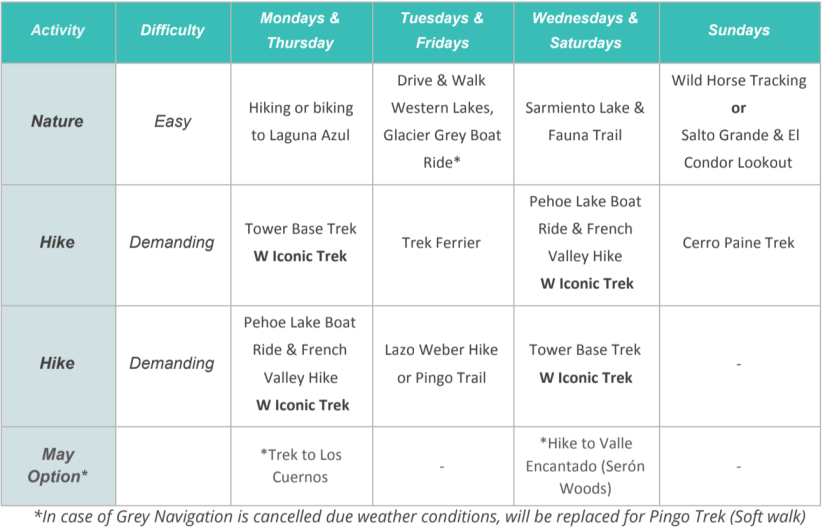
- EcoCamp Hiking Calendar
-
- I would highly recommend the Lazo Weber trek as a moderate hike and the Base of the Towers trek as a difficult hike.
- Wildlife Safari: Keep an eye out for Condors, Guanacos and Pumas.
- Glacier Boat Ride: This boat ride takes you to the Grey Glacier, which is part of the Southern Patagonian Ice Field. Note that the ferry that runs to the glacier is on a schedule and the first and last ferry can be very crowded.
What to Bring / Wear:
- In Patagonia, you can get all 4 seasons in one hour. The weather changes like crazy and for that reason, the forecast is never accurate. Dress in layers, layers, layers.
- Smart wool socks that come above the ankle
- Waterproof hiking boots
- Rain jacket
- Rain pants
- Hiking poles – these can be especially helpful when going down steep hills
- Sunscreen
- Sunglasses
- Reusable water bottle – there are many places were can you fill up your water bottle from the streams or waterfalls
- Protein bars / snacks
- Plastic bag to carry trash; there are no garbage cans along the hiking trails
- Portable charger
Accommodation:
- EcoCamp: This is the coolest place I have ever stayed. EcoCamp is a series of geodesic domes that are fully sustainable. The camp includes 33 domes, ranging from standard domes to suite domes. The camp has 3 community domes, where guests have dinner and can enjoy nightly activities, such as live music. In addition to the community domes, there is a yoga dome and a massage dome.
- The standard domes are very minimalistic, with no electricity or heating and guests staying in standard domes will have community bathrooms.
- The superior domes and the suite domes have electricity, a private bathroom and heating.
Food:
- There are no formal restaurants inside of the national park. Wherever you stay (hotel, campsite, etc.), there will be food available. At EcoCamp, the food was outstanding. For breakfast there was a buffet of food to choose from. For lunch, there was a sandwich and vegetable buffet from which you could pack your lunch. For dinner, there was 3 options for every course, always inclusive of a vegetarian option.
- In general, the local diet is very meat heavy.
- All the locals drink mate (yerba mate), which is a traditional drink that tastes like strong green tea but gives you energy like coffee. The locals drink it out of a special cup with a special straw. Definitely try it! And don’t be surprised when you see that everyone drinks from the same straw, it’s a drink that meant to be shared by everyone.
- Eat empanadas whenever you have a chance! Most empanadas are made with beef, but there are varieties with chicken, corn, etc. Most empanadas in Patagonia have hard boiled eggs in them.
Notes:
- There is no cell service in Torres del Paine.
- Bring layers! I always I had 5 top layers and 2 bottom layers with me. For my top layers, I wore a long-sleeve ski base layer, a Patagonia fleece zip-up, a down vest, my Arcteryx jacket and then my rain coat. For the bottom layer, I wore yoga pants (many people wear thermal leggings) and then my rain pants.
- I packed everything I needed for 2 weeks in an Osprey EJA 58 liter backpack. I found it very convenient to have a backpack and not a suitcase.
- For a day hiking backpack, I used the Osprey Sirrus 24 liter pack. I thought this was the perfect day pack. I would recommend getting a back that has pole holders and pockets on the hip band.
- You will see that a lot of places have windows covered in stickers from around the world. If you have a sticker you like, bring a few to leave!
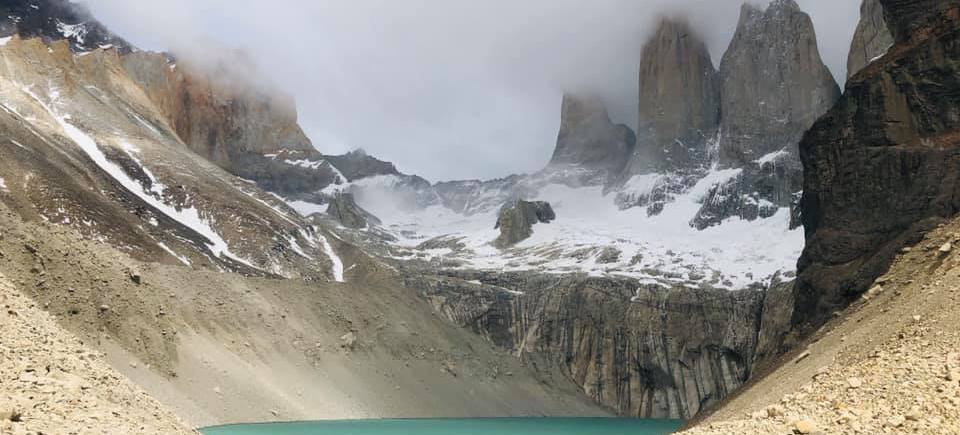
Background photo taken at Base of the Towers trek, Torres del Paine, Chile.


 The Bucket List Checklist